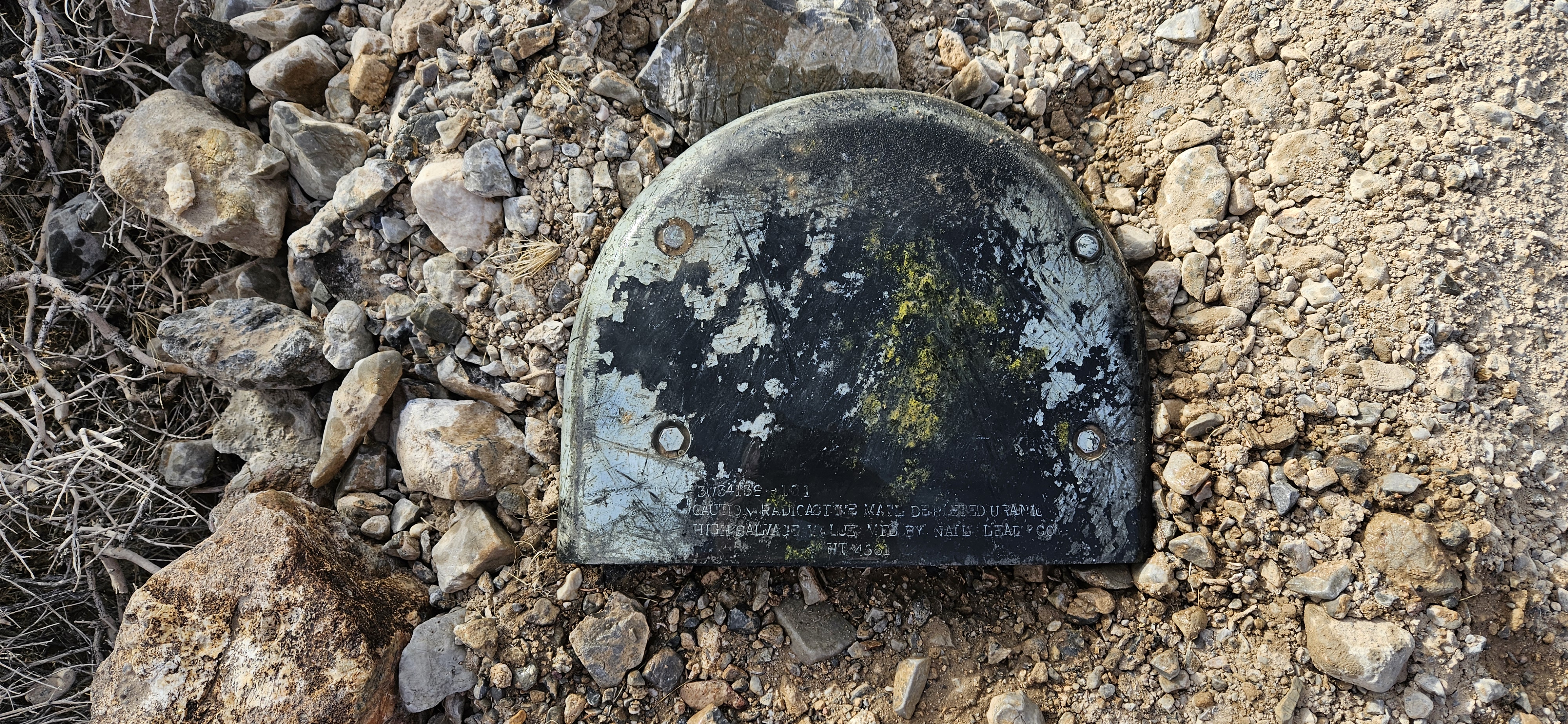
We had just found a geocache off a dirt road in Nye County, NV, and were returning to the highway."That looked interesting," Harold said as he backed the car up. He had spotted what he thought might be a door to a safe. Well, a closer look determined it was something far more interesting and that it probably shouldn't be lying next to the road. We could make out words like "radioactive, depleted uranium, high salvage value, manufactured by Nail Lead." Now, who do you call about that?
Since we were near Cheech AFB and the Nevada test site, we opted to call them. They put us in touch with Nellis AFB. Harold sent them photos. However, since the object did not say property of the US Government and it was not on government property, we would have to call the local police department. Hmm, perhaps that should have been our first call. So what county are we in and what's the non-emergency number?
While we were waiting for all the call backs, we had driven further down the highway, headed for the nearest rest area. We spotted a sign for a sheriff's substation and headed there. While the office was closed, we spotted a sheriff's department pickup and flagged the deputy down. Harold explained everything again. The deputy started making phone calls and let us know that the fire department was sending out a hazmat team. We followed the deputy back to the site and arrived the same time the hazmat team did. It was quite the spectacle on this empty stretch of road.
The hazmat team checked Harold out for radiation and started toward the object. While the radiation levels were elevated from the surrounding area, they were still in a safe zone. As Harold kept saying, it was depleted uranium. However, this is not something you want just lying by the roadside, primarily because of the metal's toxicity.
So after chitchatting with the responders while decisions were being made, providing all our information to whichever department was asking, declining medical transportation, and so forth, we left them to do their thing. The joke was that now they'd have to find the alien ship that crash landed after losing their fuel.
As for us, we still had half a day for Death Valley National Park, our original plan.
Harold used public records and determined that the object is a counterbalance weight for a C141 aircraft. How it ended up along the roadside is anyone's guess. So where did the depleted uranium end up? We received word that the Nevada state radiation control program now has it safely in custody.
 |
| An isolated road |
 |
| "That says what?" |
 |
| Checking for radiation |
 |
| Declining medical transport |
Where Are We Going Next?